

Saturday, November 7, 2026


- Article
- Comments (0)
Looking down the barrel
PARIMAL PEEYUSH | New Delhi, November 2, 2012 17:31
Tags : supreme court | CIC |
Tags : supreme court | CIC |
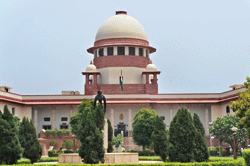 A recent Supreme Court judgment that mandates the presence of a judge or a judicial officer in Central and State Information Commissions, is set to alter the way ahead for the Right To Information Act, 2005, as it has existed so far.
The apex court in a significant order has mandated that all Information Commissions will have to include members with legal backgrounds. One of the two members of each bench will come from a legal background. It also ruled that appointments will be done in consultation with the Chief Justice of India or the Chief Justice of the High Court concerned.
The Supreme Court passed its verdict on a petition filed by Namit Sharma who said that since the work of the Central Information Commission (CIC) under the RTI Act was mainly connected to law, it would only be appropriate if members in the transparency panel have a judicial background.
The central government had earlier opposed the petition contending that the inclusion of judicial officers on the Information Commission not be made mandatory. It has now filed for a review of the order saying that “the court could not direct it to amend the RTI Act” and that the directions given in the judgment were “contrary to the provisions of the Act”.
The CIC has stated that it is in the process of studying the order to figure out its implications. With a backlog of over 30,000 applications, things have not been easy for the CIC anyway and the latest order has escalated concerns over the rising number of pendencies with Information Commissions across the nation.
However, if the initial reactions are any indication, the chaos has already begun. Soon after the ruling, RTI applications have come to a standstill. “There was no clarity on whether the commissions are to continue work or wait for further orders,” an official said.
Critics within the government have gone so far as to say that the judiciary wants to ‘corner’ the RTI machinery. On the flip side, it has been suggested that the move could give Information Commissioners and RTI more independence.
Information commissioners are currently selected by a committee comprising the Prime Minister, Union Law Minister and Leader of Opposition after an open application process. However, there have been several legitimate complaints about the functioning of the Information Commissions and Commissioners. The appointment process has also often been termed as ‘opaque and non-consultative.’ The government has a majority in the selection committee which enables it to push through a nominee of its choice.
They say that while the spirit of the act calls for appointments in commissions across sectors, the reality is that a majority of those who come on board are former bureaucrats. CIC Satyanand Mishra himself is a former bureaucrat.
It is not unknown that RTI activists have also been campaigning for their inclusion on the commissions. Understandably, their criticism over the judgment has also been pretty harsh. Transparency activists have said that the judgment “fails” to deal with several important aspects of implementation of the act and believe that the judgment will render the RTI Act ineffective.
Pointing out to the increase in pendency of cases as one of the most significant impacts of the judgment, former Information Commissioner at CIC, Shailesh Gandhi, says that the judgment may take us out of the cesspool but will throw us head down, into a valley which would be sure death. “Today, if five Information Commissioners are able to dispose of 15,000 cases every year, the present judgment of the Supreme Court will reduce the disposal rate to less than 25 per cent of current capacity,” he said.
According to him, the judgment failed to lay down norms on time-bound disposal of cases at the Commission, getting a transparent process to select the Information Commissioners and holding them accountable.
Aseem Sarode, a lawyer and human rights activist, believes that the contention that the appointment of Information Commissioners is in violation of the fundamental right of equality and freedom of expression as mentioned in Article 14, 16 and 19 of the Constitution of India, was ‘surprisingly’ relied upon by the judges.
This interpretation is misleading, he says, as the judgment does not mention as to whose fundamental rights are being infringed upon. “The Constitution has given us the right to analyse, scrutinise and discuss a Supreme Court judgment. In this capacity, I am of the view that the judgment is more of a rehabilitation programme for judges of the Supreme Court and High courts, with a sole eye on their post-retirement appointments,’’ Sarode says.
Referring to the chaos that this order was all set to create, Shailesh Gandhi said that appointments would become extremely difficult. “The retirement age of Commissioners is 65 and of Supreme Court judges is also 65. Hence only retired High Court chief justices can be Chief Information Commissioners. Where will the nation find 28 retired chief justices to head all the state commissions? Thus there will be no selection,’’ he points out.
While the extent of the impact that the SC ruling will have over the efficacy of the RTI is yet to be seen, concerns over dilution of the act have resurfaced, this time from expected quarters. On the occasion of the seventh anniversary of the RTI becoming a law, Prime Minister Manmohan Singh raised concerns over the Act “not being used to its full potential’’. “This important legislation should not be only about criticising, ridiculing, and running down public authorities,” he said addressing a convention of Information Commissioners in New Delhi.
With his government under fire over a series of scams, the PM expressed concerns about ‘frivolous’ applications and the invasion of privacy, and said that “the potential for good, constructive use of the Right to Information is perhaps far greater than what its current status would indicate.”
Considering that it was his government which claims and deserves all credit for passing the RTI Act, the PM’s comments would have been termed unexpected, only if they had not been repetitive.
Speaking on the occasion of the RTI marking six years of existence, Singh had made similar observations. “Even as we recognise and celebrate the efficacy and the effectiveness of the Right to Information Act, we must take a critical look at it. There are concerns that need to be discussed and addressed honestly,” he had said last year, going a step further to state that RTI should not impede the working of governance.
There have been attempts, primarily through amendments to rules, to keep out ‘frivolous and vexatious’ applications, observes Nikhil Dey of the National Campaign for Peoples’ Right to Information (NCPRI). “Since neither can be objectively defined, any such amendment will result in huge rejection, affecting mostly the poor and the marginalised. This issue has been repeatedly deliberated,” he says.
The Department of Personnel and Training (DoPT) dropped the amendment move after its website was flooded with adverse comments. “The National Advisory Committee (NAC) too has rejected the amendments. However, the Prime Minister continues to raise the same issue over and over,” Dey adds.
Activists have repeatedly pointed out that the law has sufficient provisions under Section 8 to reject applications that are not legitimate and the government does not qualify why the exemption for privacy under section 8(1) J is inadequate to protect personal privacy. Nor has the government laid out those cases in which personal privacy has been infringed because of the RTI Act. Even in his speech this year, the PM referred to Justice AP Shah’s report on privacy. However, this report too has recommended that any privacy law should be in harmony with, and subject to, the RTI regime.
The RTI has been under attack even before it became a legislation. Through the years, its critics (other then the PM) include the likes of former President Pratibha Patil, Congress ministers Salman Khurshid and Veerappa Moily and even the Cabinet Secretariat. While some have found it disruptive, for some it had inbuilt weaknesses. The others found it challenging and so earnestly wanted to see ‘improvements’.
The truth, however, is that people’s support for the RTI has only grown over the years. Another truth is that it is this very legislation, which the UPA had touted as one of the finest in the country so far, that has left the government uncomfortable on several occasions. This could also explain the government’s contradictions and ambiguity on how to deal with a law that has gone against it.


 Issue Dated: Feb 5, 2017

